401 authors imprisoned: the year silencing became routine
In thirty days, censorship surfaced in eight countries — US schools and courts, European centralization and arrests, silence in the monitored Asian axis.
Between April 20 and May 20, 2026, the Publitik dashboard recorded 3,093 articles from monitored editorial press. Forty-four of these dealt with censorship — just under 1.5 articles per day. This is a small volume in absolute terms, but the topic overwhelmingly leads a specific indicator: the tone of coverage. Seventy-seven point three percent of articles classified as censorship had a negative or crisis sentiment. No other topic in the database, among those with sufficient volume to be comparable, comes close to this extreme.
Note on data collection window: Publitik began continuous data collection on April 20, 2026. This is the first reading of censorship as a dedicated focus. There is no time series — only a synchronous snapshot of what was captured over thirty days, across eleven independent newsrooms in eight countries.
The dashboard’s sentiment thermometer shows censorship ahead of legal proceedings (68.3%), controversy (65.4%), and corporate crisis (65.4%). In other words: when an editorial newsroom covers censorship, eight out of ten times it is covering loss, damage, or disruption. It is not a neutral topic from an editorial perspective. It is a front of conflict.
Front 1 — United States: libraries and schools as the battle line
The American front is the most systemic of the three and the only one operating within consolidated institutional frameworks — public libraries, schools, courts. It is not a matter of isolated incidents. It is long-term litigation, with a weekly cadence of new judicial decisions.
The narrative anchor for the month was the new PEN America report, released on May 7 and replicated within a week by outlets in four countries. The document indicates that book bans in the United States are increasingly targeting non-fiction, shifting the historical focus — previously concentrated on young adult fiction with LGBTQ+ or racial themes — to non-fiction titles dealing with history, social science, and biography. Publishing Perspectives’ analysis reinforces that non-fiction has become an increasing target of banning campaigns in American schools. And Actualitté, a French newsroom covering the circuit with an external perspective, observes that essential books for students are disappearing from American schools.
The judicial layer runs in parallel. The case of Penguin Random House + Iowa Safe Schools — in which the publishing conglomerate is litigating against a state law that removed titles from school libraries — entered the phase of petitioning for an en banc hearing in an appeals court. Shortly after, the appeals court denied the request to reopen the case, closing one procedural avenue and pushing the conflict to higher instances. In Idaho, legislators even modified the state code live during a hearing on banning — the kind of procedural adaptation that signals litigation where norms and practices change at the pace of a legal process, not an ordinary legislative session.
Ukrainian Chytomo translates the scenario for Eastern European readers with the clarity of an outside observer: in 2025, US libraries banned a record number of books. The quantitative data circulates fastest — but the most relevant signal is qualitative: the target category is shifting. Non-fiction is being targeted because the axis of the dispute is widening.
There is a counterbalance — and the dashboard registers it. PEN America also awarded Tennessee library attorneys for defending reading freedom during the same period. The editorial interpretation is twofold: the legal infrastructure surrounding reading freedom is under coordinated attack and, simultaneously, is being reinforced by civic mobilization. The two dynamics operate on the same plane, at different paces.
Front 2 — Europe: centralization, blacklisting, and imprisonment
The European front does not operate through institutional bans. It operates through three parallel mechanisms: pressure from editorial centralization on critical publishers, direct criminal conviction of authors, and symbolic silencing at awards ceremonies.
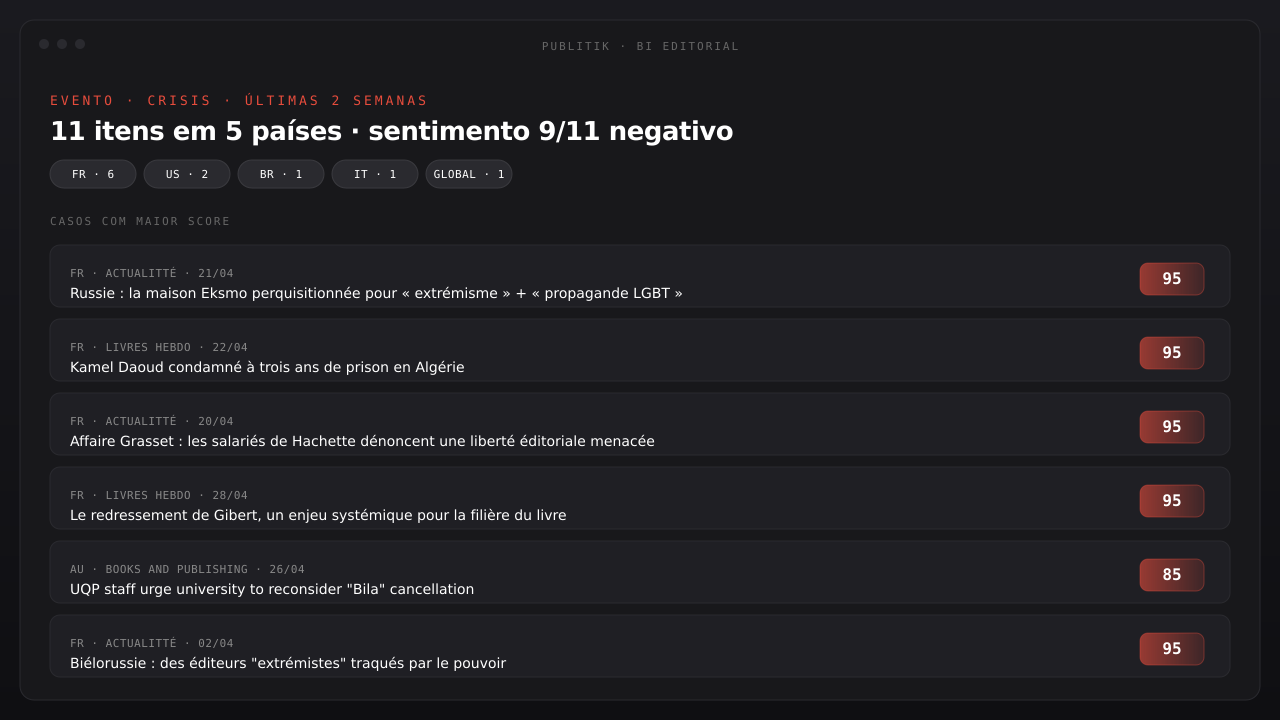
The central case of the window was the Grasset–Bolloré–Canal+ development. Actualitté covered the episode in a harsh editorial: after Grasset, Canal+ enters the list; when criticism of Bolloré leads to blacklisting. The interpretation is clear — the conglomerate controlling Hachette, Grasset, and the TV channel is accused of orchestrating retaliation against creators who publicly criticize it. Two days later, the same newsroom published a second text contextualizing the whole: Bolloré, Vivendi, Hachette: a question of control. The angle shifts from an isolated incident to a structural interpretation. Behind this, the case of Boualem Sansal — an Algerian author imprisoned for publishing with Grasset — gains a new layer when it’s discovered that Sansal was unaware Grasset belonged to the Bolloré empire when signing the contract. The geography of editorial centralization is, itself, part of the story.
The penal layer is the most serious of the month. Kamel Daoud, the Algerian author who won the Goncourt 2024 with “Houris,” was sentenced to three years in prison in Algeria for the book’s publication. The case is symmetrical to that of Russian Eksmo, the country’s largest publisher, which was raided on charges of “LGBT propaganda” — and a few days later was targeted by a new search and seizure operation for “extremism”. In Russia, the conflict even extends to past catalogs: the Russian parliament appealed to the Ministry of Justice requesting that works by Pushkin, Gogol, and Tolstoy be labeled as “drug propaganda”, and Litres began to study the labeling situation of classics. When the State requests the labeling of its own classics, the operational limit of the national publishing market shifts significantly.
The collection also captured the summary angle: Actualitté reports that PEN America recorded 401 individuals detained for their writings in 2025 — a number predominantly distributed between China and Iran, but with a significant Russian and Belarusian presence. The scale is not figurative. These are four hundred and one individuals with sentences imposed for publication in the last calendar year counted.
The European front also features two episodes, smaller in scale but high in symbolic significance. In the United Kingdom, the case of poet Abigail Ottley — censored by a small imprint after a reader’s complaint — reached the courts. And at the British Book Awards, the cover of whistleblower Sarah Wynn-Williams’ book (ex-Meta, author of “Careless People”) was visually blurred during the ceremony — likely due to a legal injunction related to the company being biographed. On the same night, Wynn-Williams shared the “Freedom to Publish” award with Epstein victim Virginia Giuffre. The act of blurring the cover during an award ceremony for freedom of publication is the kind of event that only makes sense as a telling sign of the current climate.
Germany completed the window with a case of jurisprudence: the Berlin court prohibited the Minister of Culture from calling critical bookstores “extremist”. The decision sets a precedent on the use of the term by a public official — relevant because it defines an institutional baseline where previous conflict lacked clear jurisprudence.
Front 3 — Asia: silence as data
The third front is the most uncomfortable to describe because it doesn’t exist as coverage. In thirty days, the Asian sources monitored by Publitik — Hon.jp (Japan), Bookdao and CP Today (China), Yes24, Aladin, and Oricon (KR/JP rankings) — collectively published 38 items. None on censorship. Zero. Hon.jp, alone, registered 33 articles during the period, all about market trends, AI, manga, and sales. Nothing about editorial freedom, imprisoned authors, or banned books.
This does not mean the topic is absent from the reality of Asian markets — it means these markets do not cover the topic within the monitored editorial-journalistic circuit. China appears in the Publitik window four times — all via foreign newsrooms: Actualitté addressing the issue of 401 imprisoned authors, and the crisis of the Chinese book market via disguised piracy; Ukrainian Chytomo with the case of publisher Lobster canceling the sale of a Chinese author due to his loyalty to Russia.
The interpretation is structural. The Western axis — France, United States, United Kingdom, Germany, Australia, Ukraine, Sweden — operates within an editorial pact where freedom of publication is an object of independent coverage, with its own vocabulary and reporting infrastructure (PEN America, Authors Guild, dedicated awards). The monitored Asian axis operates within another pact, where these topics do not circulate, or circulate outside the editorial circuit we index. The methodological question this raises — how many items we are missing due to a gap in unindexable or inaccessible Chinese, Korean, and Japanese sources — is a real problem for the dashboard, and it’s on the roadmap.
But even this correction would come with a low ceiling. When Actualitté needs to translate the Chinese conflict for French readers with a nine-day delay relative to the event, and Hon.jp publishes thirty-three articles in the same period without touching on the topic, the structural asymmetry is evident. It’s not a coverage gap. It’s a difference in editorial regimes.
Why reading the three fronts together matters
The question that changes when everything is observed together is not “which market is most under attack?”. It is: “how does each region absorb pressure on editorial freedom within its existing infrastructure?”.
The United States absorbs it within the school and judicial systems — pressure emerges as litigation. Europe absorbs it within the editorial press circuit — pressure emerges as harsh editorials, public denunciations, symbolic awards. Monitored Asia absorbs it outside the circuit the dashboard accesses — pressure emerges through channels that do not publish in a format indexable by an editorial aggregator. It’s not the same intensity of a topic facing three different responses. It’s three distinct editorial regimes being measured by the same thermometer.
What this means for those editing in Brazil: the interpretation of international pressure on editorial freedom needs to be weighed by regime. PEN America’s global number — 401 detained authors — is raw data. Geographical distribution is regime data. And the presence or absence of local coverage is pact data. When Brazil covers the topic, the regime is European; when it doesn’t, the regime approaches the Asian one. Which side the national market falls on will be a repeated question in the coming months.
Concluding remarks
Of the 44 articles collected on censorship in this window, 34 were classified with a negative or crisis tone. Five had a positive tone — all related to active counterweights (awards, civic defense, a Damascus bookstore reopening). The spread between negative and positive is 6.8 to 1. The thermometer registers it. The coverage confirms it. The topic leads the negativity ranking in the monitored editorial database.
What we cannot yet conclude
Publitik’s window is thirty days. It’s not possible to state that censorship is on the rise — there’s no dedicated historical data. What can be said is that, among what has been measured to date, it is the front with the highest density of negative tone and the greatest geographical dispersion among monitored newsrooms. Future readings, starting in the second half of the year, will begin to show whether this peak is structural or specific to this window.
The open question for the Asian axis is methodological: how many Chinese, Japanese, and Korean newsrooms would be necessary to confirm or refute the interpretation of a “different editorial regime”? The dashboard currently covers seven sources in these three countries. In markets with such editorial depth, seven is few. Publitik’s roadmap includes expanding Asian coverage by the end of 2026, and the next special geographical column will revisit this axis with a broader base.