What rankings from Asia, Central Europe, and Oceania reveal about the publishing market
Five new weekly lists and four international press sources join the map. Each offers unique insights: dominant formats, market segmentation, and title lifecycles.
The global publishing market suffers from uneven visibility. The UK, United States, and Brazil dominate most of the coverage available in Portuguese. What breaks in Tokyo, Seoul, Frankfurt, or Sydney often only reaches the national press radar months later, by which time it has already become licensed catalog material. This delay comes at a cost: Brazilian publishers make acquisition decisions based on outdated trend analysis.
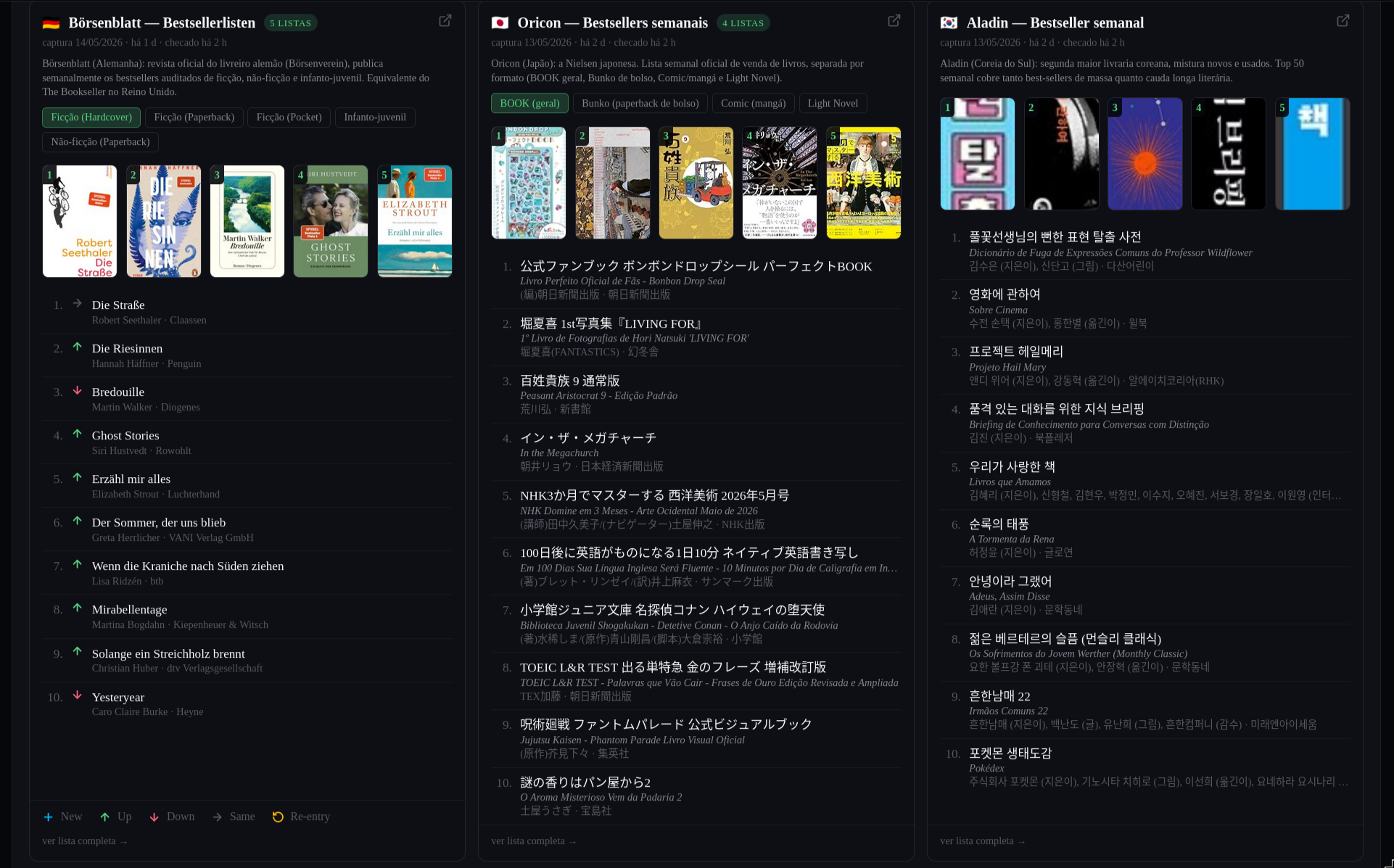
Publitik is now expanding its coverage to include five new weekly rankings—Japan, South Korea, Germany, and Australia—alongside four international specialized press sources. This expands our coverage to 22 countries. Beyond simply broadening the map, each of these lists offers unique editorial characteristics that warrant individual analysis.
Japan: the market of formats
The weekly Japanese ranking covers four separate categories: general books, bunko (pocket paperback), manga, and light novels. This segmentation is not arbitrary; it reflects the actual structure of Japanese consumption.
Bunko is the dominant format in Japanese retail: compact, inexpensive editions designed for reading on public transport. Where the Anglophone market treats paperbacks as derivatives of hardcovers, Japan considers paperbacks the primary product and hardcovers as collector’s items. The bunko list, therefore, offers the closest indication of what genuinely circulates among the average reader.
Manga and light novels receive their own lists because they move volumes that would distort any mixed ranking. A manga title topping a general list above any literary fiction would be the norm, not the exception. Separating them allows for the analysis of three parallel currents: traditional books, illustrated pop culture, and written young adult fiction.
For the Brazilian market, the manga list anticipates by months the licenses that will appear in national retail. Publishers operating in this segment monitor these rankings weekly; now this work is accessible in a single dashboard.
South Korea: a laboratory for modern commercial fiction
South Korea is currently one of the most active centers for the production of contemporary commercial fiction. Han Kang received the Nobel Prize in Literature in 2024; the genre known as K-romance is increasingly occupying young adult shelves in various Anglophone markets; and Korean self-help titles are being rapidly translated into Portuguese.
Publitik will now cover two Korean lists in parallel: that of the country’s largest e-commerce bookseller and that of its second-largest bookstore. This choice is not redundant. The first captures digital consumption—contemporary fiction, self-help, and commercial narratives that dominate online retail. The second mixes new and used titles, exposing both mass-market bestsellers and the literary long tail that thrives in urban second-hand bookstores.
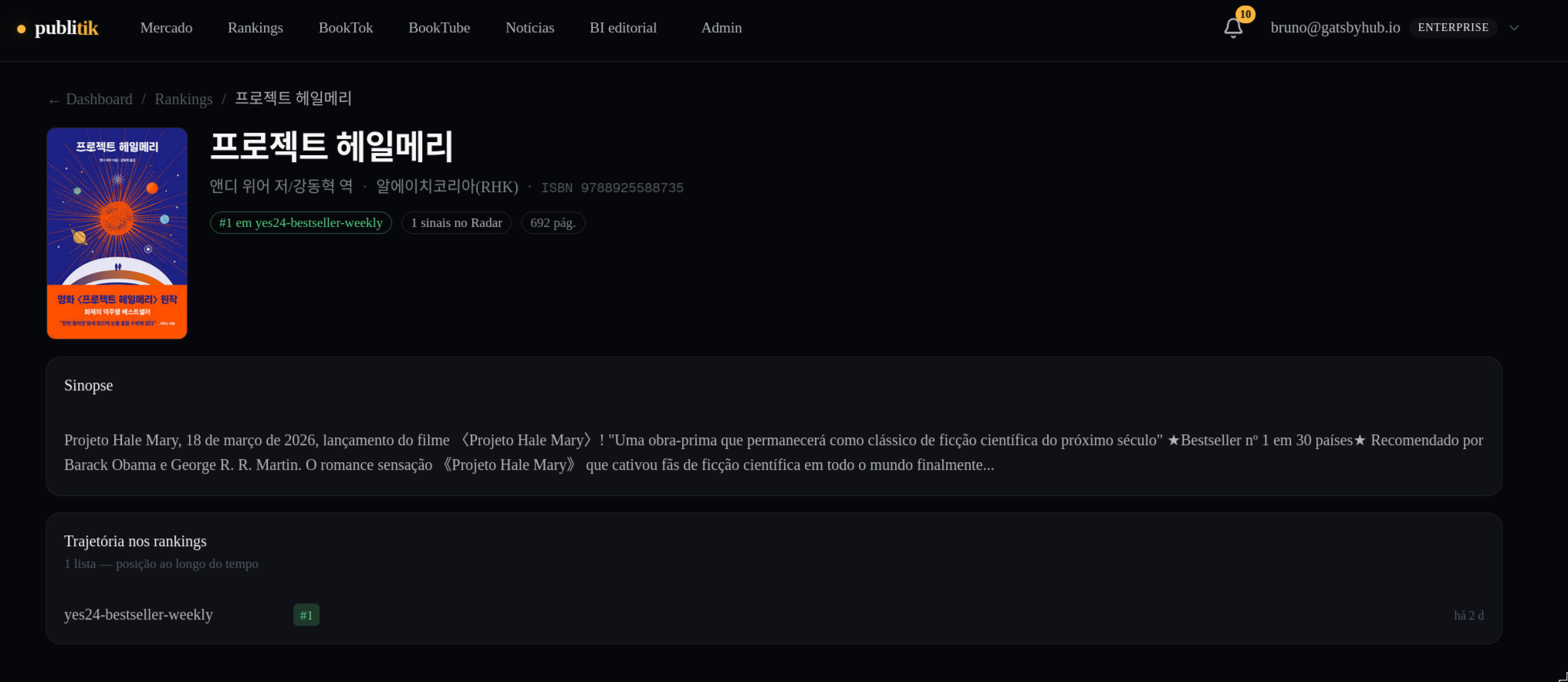
Each Korean title now appears with its actual ISBN-13, a synopsis in Portuguese, and translated categories. The alphabet barrier is no longer an obstacle to editorial assessment—Brazilian evaluators can now read Korean books with the same depth as they would an American title.
Germany: the continental canon
The German market is the largest in continental Europe. Germany’s leading bookseller trade magazine publishes five official weekly lists, audited by the national industry association—the continental equivalent of the British canon that Publitik already covered.
The internal separation of these lists is instructive. Fiction is divided into three formats: hardcover, paperback, and pocket. Non-fiction is covered in paperback. Children’s and YA has its own list. This granularity reveals the lifecycle of each title: a novel that first climbs in hardcover, then migrates to paperback, and later to pocket, behaves very differently from a title that debuts directly in an inexpensive format.
The dashboard also includes native trend indicators—rising, falling, steady, new—sourced directly from the original data. This eliminates the need for external week-to-week comparisons, providing an immediate understanding of which titles are gaining or losing traction within the German context.
Australia: the audited Anglophone signal
The Australian list is powered by official, audited retail sales data from the country. A concise weekly Top 10, it serves as a canonical signal.
Its influence is greater than the size of the Australian publishing economy might suggest. The list quickly replicates trends in other Anglophone markets—New Zealand, South Africa, and English-speaking Canada share distribution structures and reader tastes with Australia. A title that rises quickly in Sydney often reappears in Auckland and Johannesburg within a few weeks. For Brazilian publishers evaluating English-language rights acquisitions, the Australian signal serves as an early indicator of what will gain traction in the Anglophone sphere outside the United States.
Specialized press: analysis before data
Rankings provide volume; qualified editorial analysis offers context. This week, four new sources are added to the press aggregator.
The first is the corporate blog of the leading global authority on book sales—analysts who produce official Anglophone market datasets and publish public commentary on market movements. The second is communications from the main European digital distribution hub, with a consolidated presence in Brazil and regular regional reports. The third is the official channel of the world’s largest book fair, which sets the international industry agenda: awards, deals, and author movements.

The inclusion criterion is quality of analysis, not volume. These are sources that produce dense editorial material, written by those with access to primary data—unlike generic corporate releases that inflate other aggregators.
What this map reveals
Three key insights emerge when observing the complete picture.
First: commercial fiction is undergoing a geographical shift. Korea, Japan, and Germany publish new titles that reach the Brazilian market months later—by the time national critics cover them, the translated title is already on shelves. Those who anticipate the signal acquire rights within a better price window.
Second: format fragmentation is a competitive differentiator in mature markets. Japan segments by bunko, manga, and light novel; Germany by hardcover, paperback, and pocket. The Brazilian market still largely operates with a single list; understanding how developed markets interpret their own consumption patterns can inform local segmentation.
Third: the Pacific-Central Europe axis represents the largest blind spot in Portuguese-language editorial coverage. The Brazilian press closely monitors the United States-United Kingdom axis. As of this week, this other axis is now on the map.
Publitik now covers 22 countries with automated weekly data capture and daily editorial analysis from specialized press. Explore the dashboard →