Reading the publishing market in 4 seconds a day
37 newsrooms in 19 countries publishing ~100 articles daily. Who reads it all? The real cost isn't time—it's decisions made with an outdated information window.
A Brazilian publishing professional wakes up on a Tuesday and, in theory, has access to the best real-time industry diagnosis in history. PublishNews is live, Folha and Estadão have published their daily columns, The Bookseller has sent its weekly briefing, Livres Hebdo closed its edition at 4 AM Paris time, Publishers Weekly has released its rankings, Boletim Tatuí has arrived in the newsletter, and the Bookstagram feed never sleeps.
In theory.
In practice, no one reads all of it. No one should. And the metric that matters isn’t “how many articles I read today” — it’s “what decision I made with what information window.”
The true cost of information fatigue
Talking about information overload has become a cliché. But the problem for publishing professionals is specific: the decision window is narrow, and it’s constantly shifting.
A book with twelve mentions across five countries in 48 hours is one data point. That same book with two mentions in Brazil four months later is a completely different data point. Late reading isn’t reading—it’s a reading distorted by the chronology of human curation, which always prioritizes what has already been confirmed by others.
The consequence isn’t theoretical. Acquiring a title already worked on by other publishers means a bidding war. Pitching an article after two competitors have already pitched it means repetition. Identifying a trend in its second third means entering when the peak has already been captured by others.
Pre-filtering is editorial practice, not a substitute for it
The introduction of artificial intelligence into the editorial reading workflow is often presented in two ways, both incorrect:
- “AI will summarize everything for you” — a promise that becomes a commodity without added value
- “AI will write for you” — a promise that becomes a content farm without a distinct voice
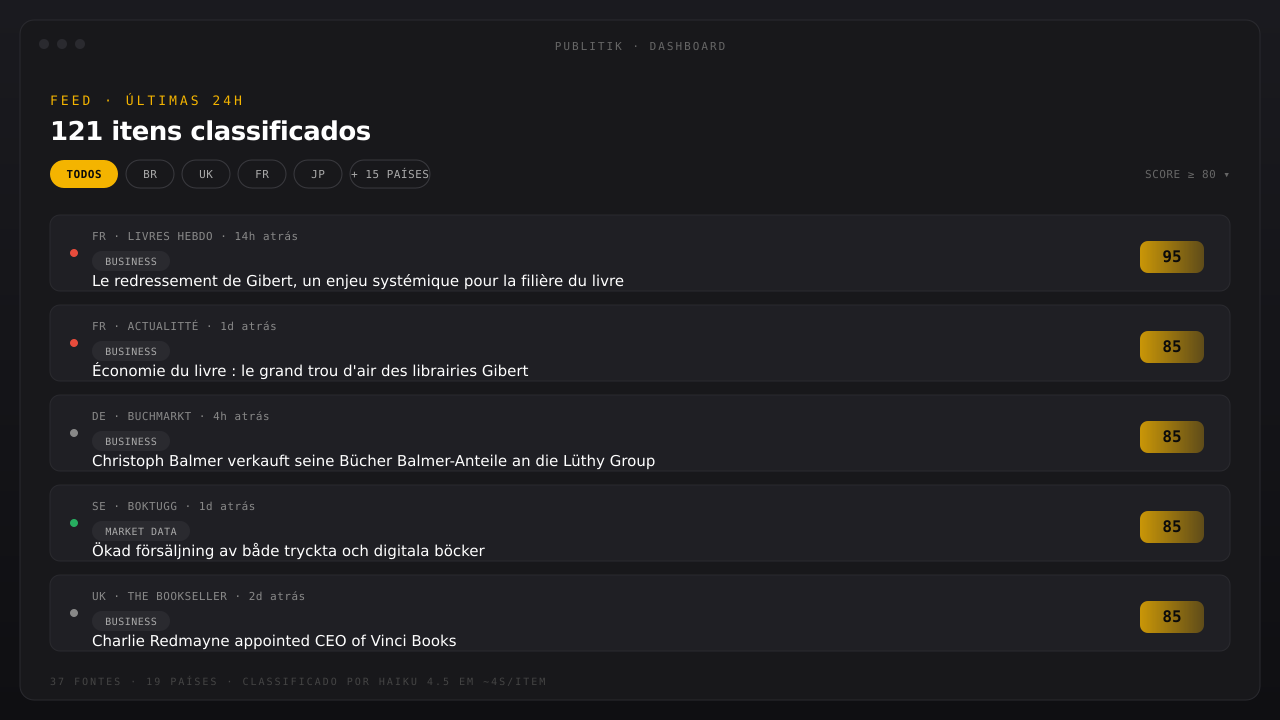
The most useful approach is the third: AI can pre-filter, but curation remains human. The model classifies each of the ~100 daily items by category, sentiment, relevance score, and geography in four seconds. The professional then enters a reduced window—perhaps 20 items with a score above their threshold—and decides what to read in full, what to archive, what to pitch, what to acquire.
AI isn’t telling you what matters. It’s answering “of what appeared today, what has a chance of mattering to you?” — and it’s up to the reader to confirm or discard. The gain isn’t in the reading; it’s in the time saved to act afterward.
Where this becomes concrete decision-making
Quality pre-filtering changes three aspects of a publishing professional’s day:
Acquisitions and scouting. Instead of discovering a trending title through a third intermediary (agent, professional reader, influencer post), the scout sees in their own matrix that this title has gone from two to twelve mentions across three countries in 96 hours—and decides to make an offer before the peak becomes obvious.
Editorial agenda. The cultural journalist doesn’t need to guess which release will dominate conversations next week—they see through the ‘Trending Topics’ lens which themes have crossed the threshold in the last 48 hours and initiate discussion first.
Independent bookstore purchasing. The neighborhood bookseller gains the same radar that large chains have by department—they know which children’s and YA book has surged in regional mentions before the month’s shipment closes.
The new metric is ‘decision per hour’
Publishing professionals used to measure productivity by content read—newsletter opened, clipping archived, page scrolled. The next generation of practice measures by informed decision per hour of work: how many concrete choices (acquire, pitch, propose, dismiss) you can finalize within the current window.
Well-used AI doesn’t diminish reading. It increases the frequency of decision-making. And it’s in this cadence—of concise reading, clear decision, open window—that the Brazilian publishing professional finds a real competitive advantage against a sector that, abroad, has already been operating with this instrumentation for at least two years.