Three fronts open in the publishing market — what the panel revealed in recent weeks
Editorial freedom under pressure, a crisis in book retail, and AI impacting the production chain. These three fronts emerged simultaneously in at least nine countries.
Publitik began continuous data collection in recent weeks. This short interval doesn’t allow for comparisons with previous months or time-series analysis — that will come in the months ahead, as the panel’s historical data grows. What can be done with integrity, however, is to examine the relative distribution of what entered the window: how much each topic weighs, in how many distinct countries it appeared, with what average sentiment, and which specific cases drove relevance scores.
In this exercise, three fronts emerged simultaneously in the recent flow from the 37 newsrooms covered. These aren’t new topics — but their concurrent appearance across independent markets is, in itself, a significant signal.
Front 1 — editorial freedom under pressure
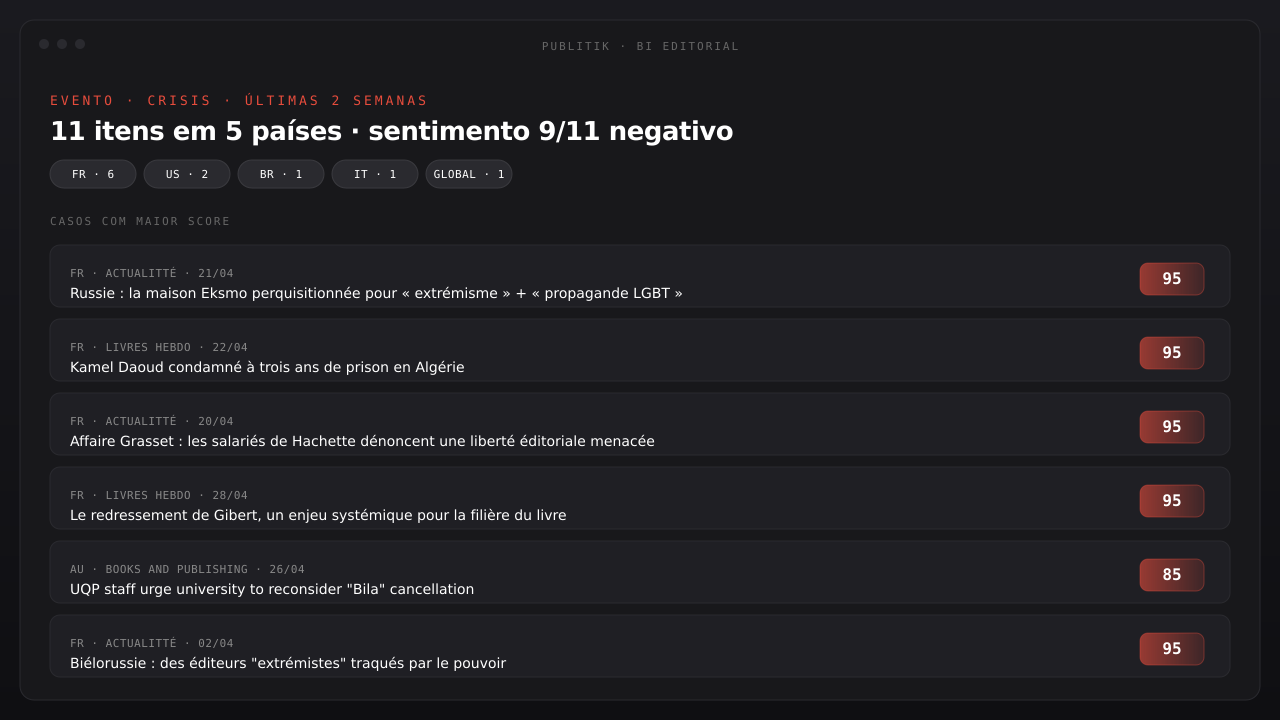
The most prominent front of the period isn’t new as a topic, but its geographical synchronicity within the observed window is striking. The panel detected cases in at least five countries, originating from newsrooms that historically operate at different editorial paces:
- Algeria. Kamel Daoud sentenced to three years in prison for the publication of “Houris” — a case covered by French newsrooms Actualitté and Livres Hebdo with a relevance score of 95.
- Russia. Eksmo, the country’s largest publisher, was searched on charges of “LGBT propaganda” and “extremism.” The case was reported by three Francophone sources within a 48-hour window.
- Belarus. Publishers classified as “extremists” are being targeted by state power.
- France. The Grasset Affair — 115 authors announced their departure after the dismissal of publisher Olivier Nora, decrying “authoritarianism.” This remained a prominent, contentious topic for days.
- Australia. The university publisher UQP was pressured to withdraw a children’s edition (“Bila”) following cultural objections — staff and author Araluen publicly severed ties with the house.
The cross-referenced reading offered by the panel in this case is less about volume and more about narrative distance. Algeria and Australia are rarely covered on the same editorial axis. When they appear covering the same type of event — pressure on a publisher, catalog withdrawal, conviction for publication — the coincidence serves as a valuable analytical tool.
Front 2 — economic crisis in book retail
The second front is financial, more severe, and geographically more concentrated. Over a hundred articles were classified as “crisis” by the panel within the observed window, across nine distinct countries.
The central case was the French bookseller Gibert filing for redressement judiciaire (court-supervised reorganization). Five articles were dedicated solely to this case, alternating between Livres Hebdo and Actualitté, with relevance scores ranging from 85 to 95. Both newsrooms covered it from different angles: court approval, a systemic reading for the book supply chain, and lessons for suppliers.
- “Le redressement de Gibert, un enjeu systémique pour la filière du livre” — Livres Hebdo, score 95
- “Économie du livre : le grand trou d’air des librairies Gibert” — Actualitté, score 85
- “Ce que le redressement de Gibert enseigne aux fournisseurs” — Livres Hebdo, score 85
The Gibert situation exemplifies a physical retail model no longer supported by current operations — and the “systemic” interpretation by the Francophone press underscores that the newsroom wasn’t covering an isolated incident, but rather a symptom.
In parallel, Aschehoug in Norway postponed an acquisition offer deadline (a sign of uncertainty in exit pricing within the publishing chain), and Hon.jp reported a significant drop in monthly book + magazine revenue in Japan. Three unconnected points, same axis.
Front 3 — AI impacting the production chain
The third front appears the most “technological” but is generating the most mature editorial debate. Nearly eighty articles with the topic “generative-AI” were observed within the window, across six distinct countries, covering completely different angles:
- Amazon tightens the screws — platform stiffens criteria for AI-generated books (Actualitté)
- French law under discussion regarding AI applied to cultural content (Livres Hebdo)
- PublishNews “Roundup” highlighting controversies between publishers and AI companies in Brazil
- Folha — Books on AI in Brazilian editorial translation (“between tool and threat”)
- Spirou 100% AI — French magazine issue entirely generated by AI, met with hostility
- Swedes reject AI-generated books — Boktugg covering consumer reception
- Ghostwriting Industry Group publishing “best practices” for AI (PW, United States)
- Readow using AI to recommend books based on user preferences (Dosdoce, ES)
The cross-referenced reading in this case is fascinating: the United States is institutionalizing the debate (best practices, ghostwriting), France is legislating, Sweden is observing consumer reception, and Brazil is discussing it at the craft level (translation). Each newsroom covers AI at a distinct phase of the same adoption curve.
Why reading the three fronts together matters
Each of the three fronts has a distinct natural audience. Editorial freedom appeals to editors and catalog directors. Retail crisis concerns distributors, booksellers, and publishing CFOs. AI engages technology, HR, and legal departments. Traditionally, each of these three is a subject for a separate forum.
The simultaneous reading changes the question. Instead of “what’s happening in my segment?”, the question becomes “what is pressuring the entire sector simultaneously?” — and the answer from this short window was: three significant pressures, with concrete cases in independent markets, all within the same interval.
What cannot yet be said
Publitik began continuous collection only a few weeks ago. Period-over-period comparisons — “topic X grew N% vs. previous month” — will become meaningful starting in the second half of the year, once the panel has its own complete historical data.
What can be stated now, with integrity, is the relative distribution within the collected window: how much each topic weighs relative to the total volume, in how many distinct countries it appeared, with what average sentiment, and which specific cases had the highest relevance scores. This is the instrument used in this post.
Future posts in the weekly column will begin to outline its own time series — what has increased, what has cooled, which front is accelerating. The first complete window for this analysis will be available starting in June.