What it took to build Martha
Martha researches Publitik's archive and shows the sources behind every answer. Here is what had to be built before she could answer her first question.
On September 30, Martha went live for Publitik subscribers on the Pro and Enterprise plans. She is Publitik’s research agent: you ask a question about the publishing market, she searches the material the platform tracks every day, and she answers while showing where each piece of information came from.
Put that way, it sounds simple. It was not.
The visible part is the conversation. Behind it are months of work organizing news coverage, bestseller lists, videos, rights deals, market studies, and books so that an agent can research them without taking shortcuts or filling gaps on her own. The language model matters, but it is only one part of that structure.

The model was never the center
Today, it is relatively easy to hire a language model, write a set of instructions, and put a chat interface online. The answer sounds fluent and confident, while often hiding the most important question: where did this come from?
That question guided the way Martha was built. In technology, we use the word harness for the structure around the model. The harness defines where the agent can search, how she checks what she found, when she needs to try again, and when the honest answer is to say she does not know.
I have repeated the same line for some time, and Martha may be the clearest way to explain it: the harness matters more than the model. You can have the best AI in the world and unlimited tokens, but without experience, curation, and a deep understanding of the architecture, the answer does not hold up.
Models will keep changing. Publitik evaluates those changes and replaces what runs underneath when doing so improves the product. What remains is the editorial structure around them. That is the part that took months to build.
The archive came first
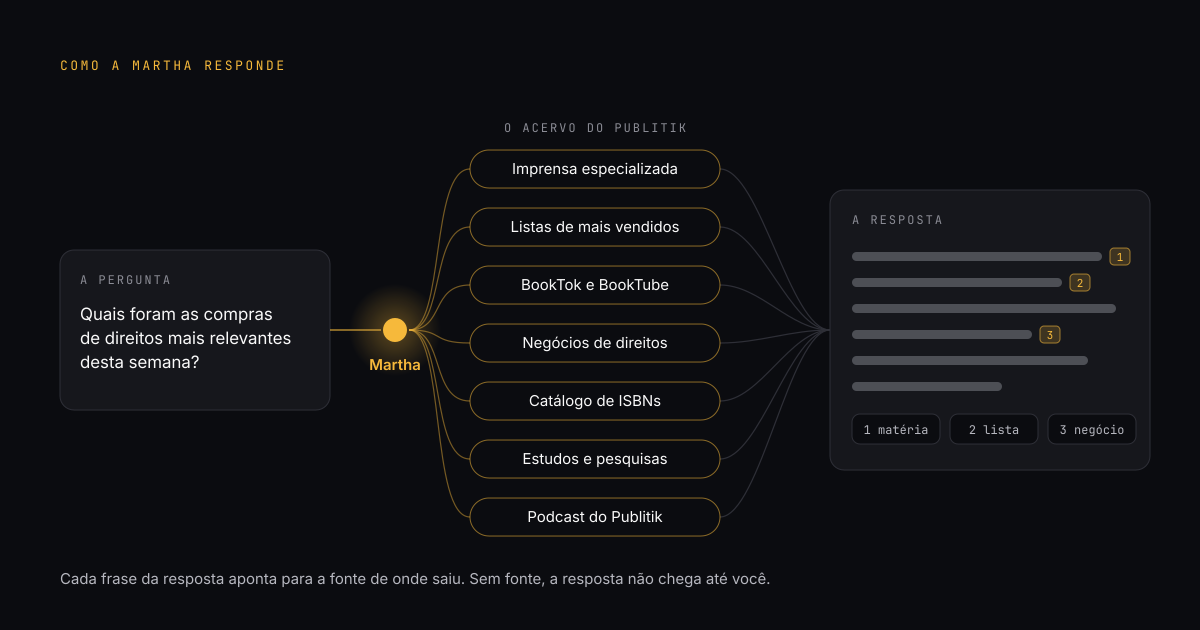
Martha did not begin with a chat box. She began months earlier, when Publitik started collecting, classifying, and connecting what happens across the publishing market. Since April, the archive has brought together specialized publishing coverage, bestseller lists, BookTok and BookTube videos, rights deals, and market studies. It also includes Brazil’s ISBN catalog through our partnership with MVB.
Each of these areas speaks a different language. A bestseller list has a position, a week, and a country. A video has a creator, its reach, and the books that appear in it. A rights deal records who acquired a title, from whom, and for which territory. A catalog record contains an ISBN, edition, format, price, and subject classification.
Making all of this work together took far more effort than building the field where the question is typed. A standard text search cannot handle this kind of research on its own. Each area therefore needed its own tool, designed around the questions publishing professionals actually ask.
The questions are also building Martha
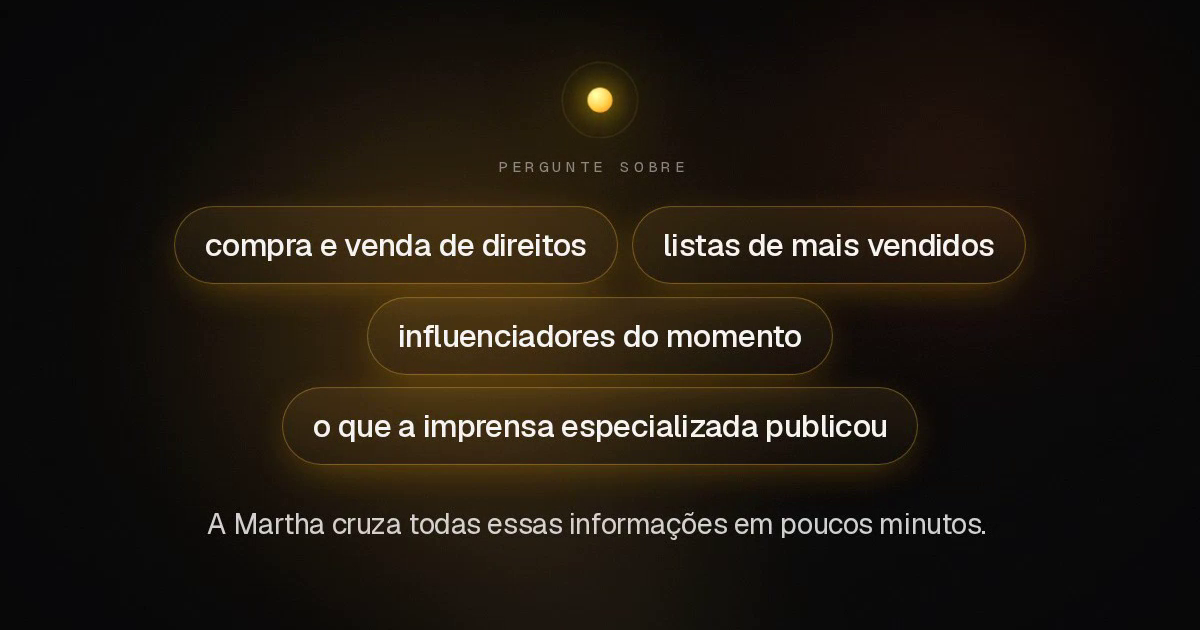
When someone asks about the week’s most relevant rights acquisitions, Martha checks the deals organized by Publitik and points to the article behind each one. If the question is about bestsellers in Brazil, she reads that week’s lists and shows the books in the positions where they appear. When the subject is influencers, she looks for the highest-reach videos in the period and identifies who is talking about which titles.
Some of her most useful tools came directly from questions she could not answer. During testing, someone at a publishing house asked for the catalog data of a children’s book because they needed it for a registration. The first version of Martha refused the question because it appeared to fall outside her scope. The question was perfectly valid. The scope was wrong.
That failure led to a new capability. Martha can now retrieve the catalog record for a title, including all available editions, and show the source. This process continues. Every question that does not receive a good answer becomes a test case. Before a change goes live, Martha has to face the real questions she has already received all over again.
Getting the data right is still not enough
Finding the right information is only half the work. The other half is understanding what it means inside the publishing market.
Every factual statement Martha makes therefore points to the article, list, video, study, or deal it came from. She works only with Publitik’s archive, without using the open web or the model’s memory. If a book is number one on a list, she does not turn that position into a sales figure, because one does not prove the other. When she uses a number reported by an outlet, she names the outlet. If a search returns nothing, she explains that she did not find enough evidence instead of concluding that the subject does not exist.
I did not write these rules in an afternoon. They came from the years I spent across bookselling, publishing, and the specialized press, living with this market’s questions, necessary caution, and dangerous shortcuts. To me, that is Martha’s editorial soul: real experience translated into a responsible way to research.
Why there is a question limit
There is another part of this story that needs the same level of honesty. Martha is expensive to operate. Every question triggers research across different parts of the archive, connects the results, checks the sources, and only then produces an answer. As the volume of questions grows, the processing structure grows with it.
At this stage, Pro subscribers can make 10 answered queries a day. On Enterprise, each team member has 20. The trial also includes 10 a day. The dashboard shows the remaining balance, and a question that fails or has to be refused does not count against it.
It is important to separate volume from research quality. The limit applies to the number of questions asked in a day, not to the care given to each one. Martha consults the areas she needs and gathers the available sources to answer the question in front of her. She does not perform a smaller search to save a query.
This is how we can keep the project sustainable while learning from real usage and working to reduce the cost of each piece of research. We are also studying changes to the structure that could increase this volume in the future without weakening the answers or making the operation unsustainable.
That cost also helps explain Publitik’s new prices for subscribers joining from October 1 onward. Martha is not simply a chat box added to the dashboard. She is part of a collective-intelligence project built on the publishing market’s shared memory. That memory can help researchers and journalists recover context, allow editors to follow the cycle of rights acquisitions and sales, and give marketing teams a clearer view of influencers and emerging trends.
Building this memory changes Publitik’s cost structure. We prefer to say that plainly: part of the new price supports the processing and ongoing work Martha needs to research well, learn from her mistakes, and become more useful to the market over time.
The name
When it was time to name the agent, I chose Martha for two reasons: “Martha My Dear,” by Paul McCartney, and a publishing professional I care deeply about.
A woman’s name also felt right. Women make up most of the publishing workforce, are the country’s largest group of readers, and, in many teams, hold the memory of how things actually work. Martha tells this story herself when someone asks.
Beta, because we are still learning
The word “beta” appears beside Martha’s name because I do not want to hide what still needs to improve. I want to discover that through real questions and fix each failure so it does not happen again.
Every answer can receive a 👍 or 👎 rating and a comment. That feedback reaches us attached to the question that produced it. When Martha fails or has to refuse a question, she says so, and the attempt is not deducted from the daily allowance.
Martha is now available on the Pro and Enterprise plans. Subscribers will find her in the dashboard. For everyone else, the 7-day trial unlocks the Pro features, including Martha. See the plans.